|
Your first picking techniques will be the “pinch” and the “bum ditty,” and you’ll learn how to use them in the context of an old favorite that BB calls “Boil Them Cabbages Down.” More commonly known as “Boil (or Bile) Them Cabbage Down,” this ubiquitous folk ditty is a great first banjo tune. BB starts by showing you the three chords you’ll need for playing “Boil Them Cabbage Down” in the key of G: G, C, and D. Then she’ll show how to play the basic melody and combine it with a “pinch” and a “bum ditty.” In this video, BB shows you a basic “pinch” for playing two strings together using the thumb and middle finger, and walks you through the first half of the melody and how to combine that with the pinch.
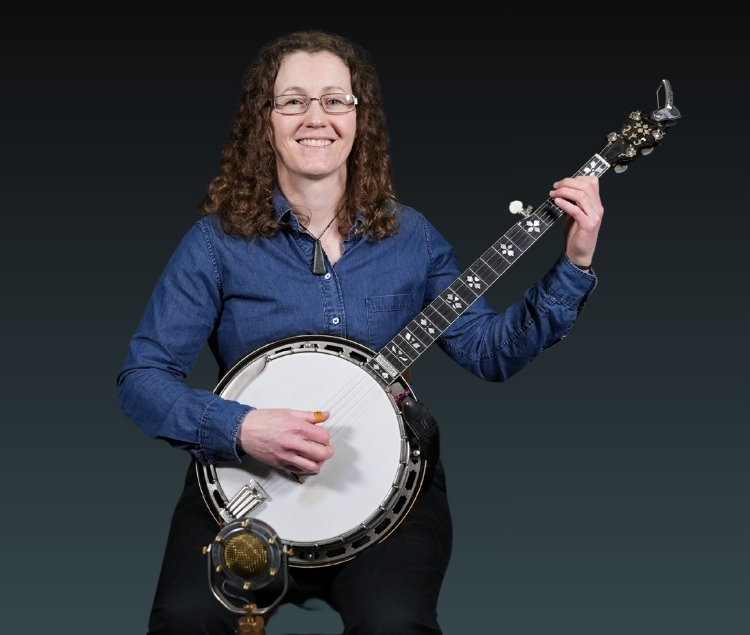
In this video, BB gives you an overview of what you’ll learn in her Beginning Banjo by Ear course. The course title says it all. You’ll learn to play the banjo as generations of players have done in the past—by ear! As you build a repertory of bluegrass classics, you’ll learn to embellish the melodies with essential banjo rolls and ornaments, and develop essential picking and fretting techniques without tab or notation.
Learn all about your dynamic banjo instructor in this video, in which BB tells you about her bluegrass banjo journey. She started off in New Zealand where she was the New Zealand School of Music's first banjo student, traveled on to the Boston area where she began playing with some of the country’s best musicians, toured the globe and recorded with the highly regarded Mile 12 bluegrass band, and just recently released her first solo album.
In these introductory lessons, you’ll learn everything you need to know to get started, including banjo anatomy, an ideal playing posture, how to tune, how to use thumb- and fingerpicks, and where to place your hands.
In these next lessons, you’ll learn some fundamental picking techniques, including the “pinch,” the “bum ditty,” the “drop-thumb” roll, and more.
BB calls it “Boil Them Cabbages Down,” but “Boil (or Bile) Them Cabbage Down” is the more common moniker for this ubiquitous folk ditty. Whatever name you prefer, it’s a great first banjo tune. BB starts by showing you the three chords you’ll need for playing “Boil Them Cabbage Down” in the key of G: G, C, and D. Then she shows how to play the basic melody and combine it with a “pinch” and a “bum ditty.”
The banjo “roll” is the defining technique of three-finger bluegrass banjo. Rolls come in many different picking patterns, and in this lesson, BB shows how to integrate a drop-thumb roll (sometimes called a “square roll”) into the chord progression for “Boil Them Cabbage Down,” which you learned in the previous lesson.
In this lesson, you’ll learn to integrate the drop-thumb roll you just learned with a fun song with old-time lyrics called “Lazy John” from Kentucky fiddler Clyde Davenport.
BB returns to “Boil Them Cabbage Down” to introduce a classic banjo roll from bluegrass great Sonny Osborne. The Osborne roll can be shifted to other strings, but for this lesson, the pattern is middle finger on the first string, index finger on the second string, middle finger on the first string, and thumb on the fifth string: middle, index, middle, thumb.